
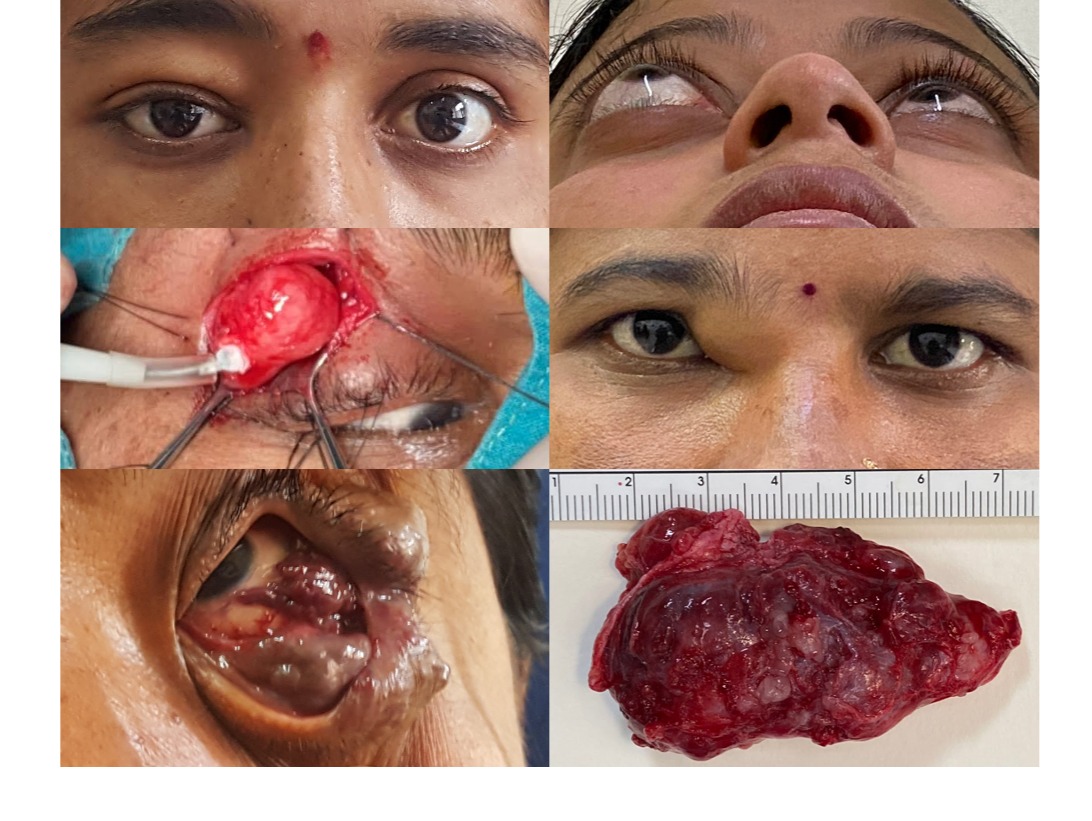
The orbit is the bony socket containing the eye, muscles, optic nerve, blood vessels and supporting tissues. Orbital disease can affect eye position, movement, vision and facial appearance at the same time.
Ocuprime provides diagnostic and surgical care for structural, vascular, inflammatory and neoplastic orbital conditions, with an emphasis on protecting the optic nerve and restoring anatomy.
At a glance
Conditions and treatments
- ✓Orbital and adnexal tumor surgery
- ✓Orbital malignancy care
- ✓Secondary glaucoma assessment
- ✓Orbital fracture repair
- ✓NSOID management
- ✓Thyroid eye disease management
Orbital and adnexal tumors
Orbital masses may cause proptosis, double vision, deep pain or reduced vision. They can arise within the orbit, extend from nearby structures or spread from another organ.
Imaging and planning
Contrast-enhanced CT, MRI and ultrasound help define the lesion and its relationship to the optic nerve, muscles and orbital bones.
Customized orbitotomy
Anterior, transconjunctival, lateral or combined approaches are selected for biopsy or tumor removal while protecting vision and eye movement.
Tumor range
Care includes benign and malignant lesions such as cavernous hemangioma, dermoid cyst, schwannoma, lacrimal-gland tumors and lymphoproliferative disease.
Orbital malignancies and multidisciplinary oncology
Biopsy and profiling
Incisional or excisional biopsy with histopathology and immunohistochemistry supports diagnosis and staging.
Coordinated treatment
Medical and radiation oncologists are involved when radiation, chemotherapy or targeted therapy is required.
Exenteration and reconstruction
Advanced, non-salvageable malignancies may require exenteration followed by reconstructive and prosthetic rehabilitation.
Secondary glaucoma and orbital pressure
Tumors and vascular malformations can raise orbital or episcleral venous pressure and contribute to secondary glaucoma.
Assessment
Evaluation distinguishes direct mass effect from altered venous drainage and identifies risk to the optic nerve.
Treatment
Managing the primary orbital cause through surgery or medical therapy can help relieve pressure and protect optic-nerve function.
Orbital trauma and fracture repair
What it is
Blunt trauma may fracture the orbital floor or walls, causing double vision, restricted movement, enophthalmos or cheek numbness.
Our approach
Reconstructive surgery releases trapped tissues and restores bony contours with an implant selected for the individual defect.
Non-specific orbital inflammatory disease (NSOID)
What it is
A non-infectious, non-neoplastic inflammatory disorder affecting orbital fat, muscles or lacrimal gland, often with pain, swelling, redness or double vision.
Our approach
Evaluation excludes infection and malignancy. Treatment may include corticosteroids, other immunosuppressive medicines or biologic therapy, with biopsy when indicated.
Thyroid eye disease
Active phase
Medical treatment and ocular-surface protection aim to control inflammation and protect vision.
Stable phase
Rehabilitation may include orbital decompression, strabismus surgery and eyelid-retraction repair according to need.
Related educational material
Clinical and surgical recordings may contain sensitive medical imagery.
Academic references and authored works
- Sharma H, Yadav SP. Orbital and Adnexal Tumors. In Oculoplastic and Orbit Casebook. ↗
- Yadav SP. Glaucoma Related to Ocular and Orbital Tumors. IntechOpen. DOI: 10.5772/intechopen.96907. ↗
- Yadav SP, Puntambekar A, Patil T, Deshpande R. Eyelid Lesion as a Presenting Sign of Pancreatic Adenocarcinoma. Ophthalmic Plastic and Reconstructive Surgery. 2020;36(6):e149-e152. ↗