
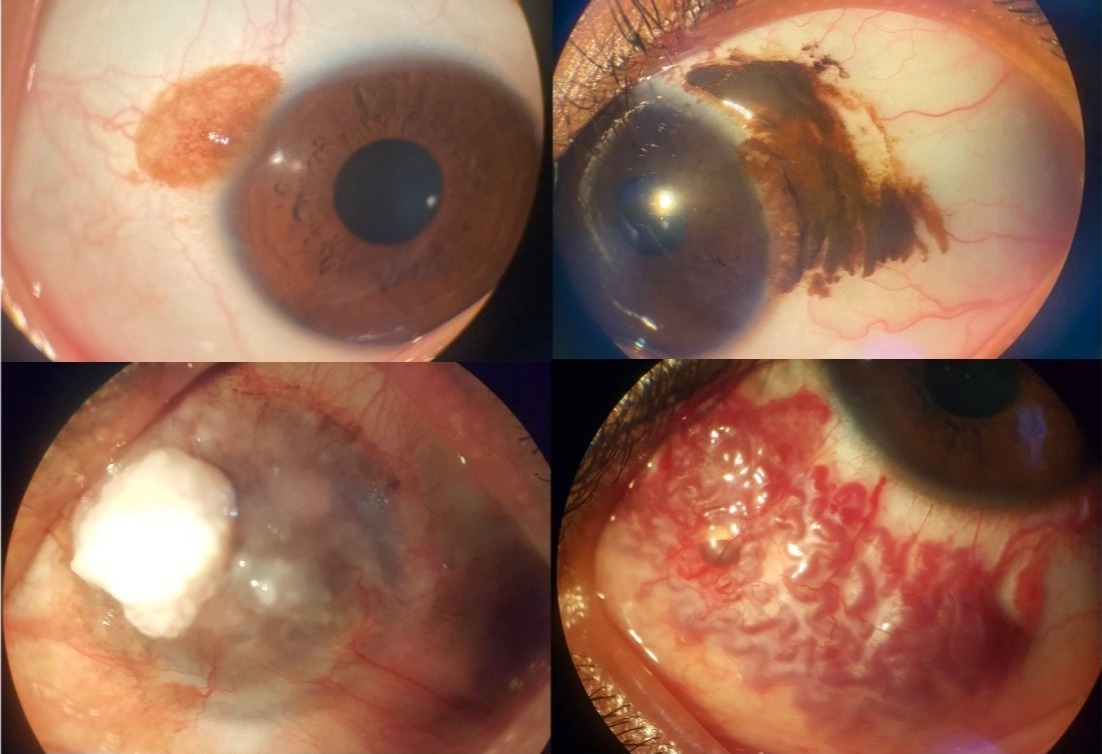
The ocular surface includes the cornea, conjunctiva and limbus. Lesions in this region range from benign pigmented spots and inflammatory masses to aggressive malignancies.
Ocuprime's ocular oncology and oculoplasty service focuses on early diagnosis, tumor control and microsurgical reconstruction that protects ocular function and appearance.
At a glance
Conditions and treatments
- ✓OSSN topical therapy
- ✓OSSN excision and reconstruction
- ✓Conjunctival lesion biopsy
- ✓Conjunctival melanoma treatment
- ✓Ocular-surface vascular tumor management
Ocular surface squamous neoplasia (OSSN): topical therapy
What it is
OSSN is a spectrum of dysplastic and cancerous growths of the conjunctiva and cornea, often appearing elevated, fleshy or white with prominent blood vessels.
Our approach
Selected diffuse, multifocal or extensive lesions may be treated with topical interferon alpha-2b, 5-fluorouracil or mitomycin-C, with the medicine and schedule individualized to the lesion and patient.
OSSN: surgical excision and reconstruction
When surgery is considered
Thick, nodular or localized lesions may require removal for diagnosis and control.
Tumor removal
A no-touch microsurgical technique, margin treatment and histopathology are used to reduce cell seeding and assess clearance.
Reconstruction
Amniotic membrane or conjunctival grafts can restore the surface and support epithelial healing.
Conjunctival lesions and inflammatory tumors
What they include
Pigmented lesions such as nevi and primary acquired melanosis, as well as uncommon inflammatory masses, can resemble tumors.
Our approach
Suspicious lesions are documented and, when indicated, removed or biopsied for definitive histopathological diagnosis.
Conjunctival melanoma
What it is
A rare malignant tumor that may arise from primary acquired melanosis or a pre-existing nevus.
Our approach
Management may combine wide no-touch excision, cryotherapy, surface reconstruction and selected topical adjuvant treatment.
Vascular tumors of the ocular surface
What they include
Pyogenic granuloma, hemangioma, lymphangioma and vascular malformations may cause bleeding, irritation or a visible mass.
Our approach
Treatment is selected according to lesion type, size, depth and blood flow, and can include medication, intralesional therapy, excision, cautery or cryotherapy.
Academic references and authored works
- Chaugule SS, Park J, Finger PT. Topical chemotherapy for giant ocular surface squamous neoplasia of the conjunctiva and cornea: Is surgery necessary? Indian Journal of Ophthalmology. 2018;66(1):55-60. ↗
- Yadav SP, Patil SS, Deshpande RD. Management of ocular surface squamous neoplasia extending up to a filtering trabeculectomy bleb. Indian Journal of Ophthalmology. 2020;68(11):2540-2542. ↗
- Yadav SP, Patil S, Puntambekar A, Deshpande R. Kimura's disease involving the conjunctiva. Journal of Clinical Ophthalmology and Research. 2020.