
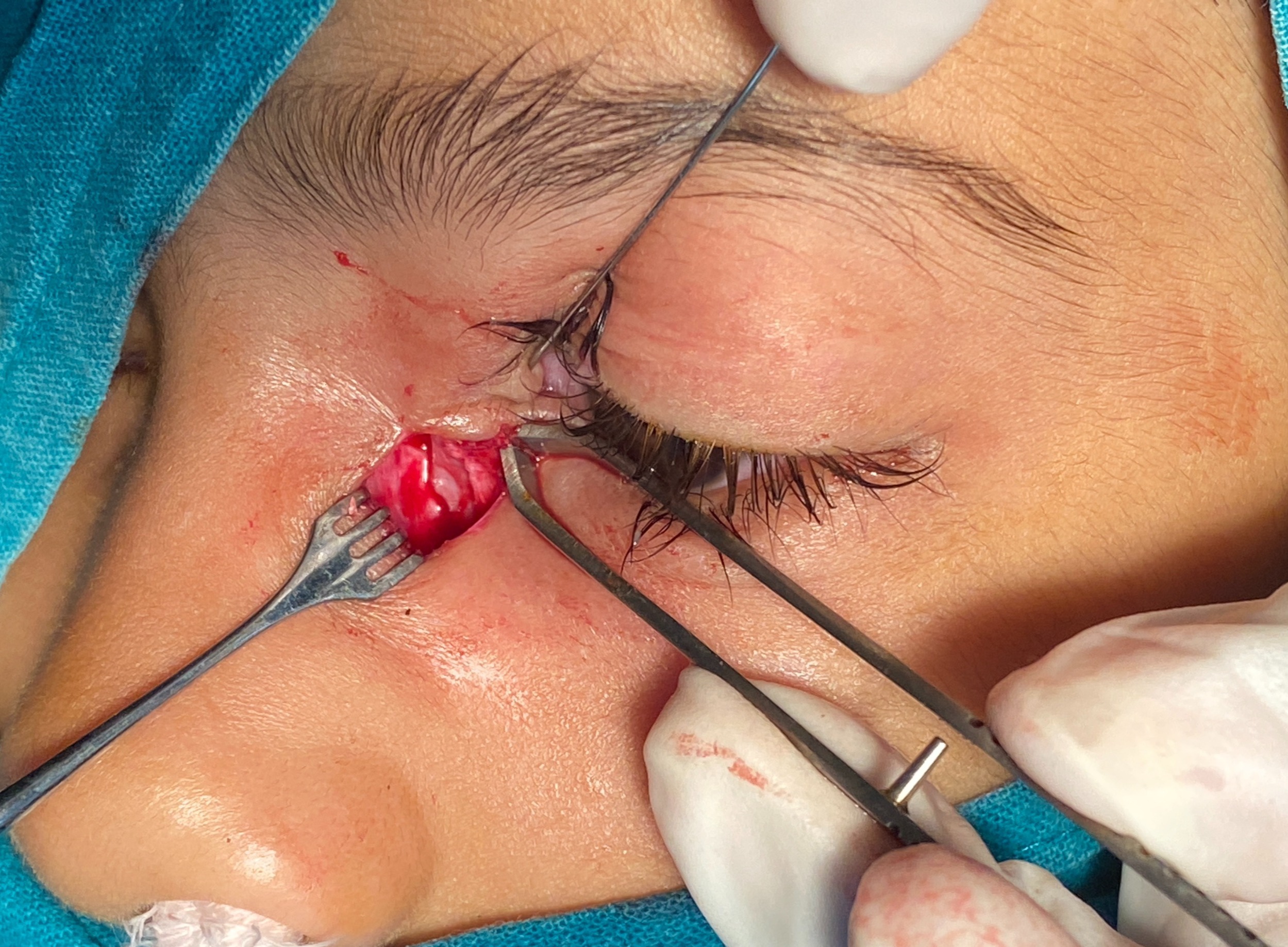
The lacrimal drainage system carries tears from the eye surface into the nasal cavity. A blockage, narrowing or injury can cause overflowing tears, sticky discharge, recurrent infection and blurred vision.
Ocuprime offers evaluation and microsurgical treatment for tear-drainage disorders in adults and children.
At a glance
Conditions and treatments
- ✓Probing and syringing
- ✓Punctoplasty
- ✓External and endoscopic DCR
- ✓Dacryocystectomy
- ✓Canalicular tear repair with stenting
Probing and syringing
What it is
A diagnostic procedure in adults and a treatment for congenital nasolacrimal duct obstruction in infants with persistent watering and crusting.
Our approach
When massage has not resolved an infant's blockage by the appropriate age, a fine probe can open the membrane at the lower end of the tear pathway.
Punctoplasty
What it is
Narrowing of the punctum—the small drainage opening at the inner eyelid—prevents tears from entering the canaliculus.
Our approach
A minimally invasive procedure widens and reshapes the opening using a technique suited to the degree and pattern of narrowing.
Dacryocystorhinostomy (DCR)
What it is
DCR treats lower tear-duct obstruction by creating a new pathway from the lacrimal sac into the nose.
External DCR
Repair through a small incision placed beside the nose.
Endoscopic DCR
Repair performed through the nasal passage without a skin incision.
Dacryocystectomy (DCT)
What it is
Removal of the lacrimal sac may be appropriate when DCR is unsuitable, including selected patients with significant medical conditions, severe dry eye or suspected lacrimal-sac disease.
Our approach
Removing the diseased sac addresses the source of recurrent infection after individualized assessment.
Canalicular tear repair with stenting
What it is
Trauma near the inner eyelid may divide the canaliculus and cause permanent tearing if the channel scars closed.
Our approach
Microsurgical realignment is supported by a temporary silicone stent while the tear channel heals.